I watched Yi Yi
and thought of Sentimental Value
Note: I mention plot points from both films. Not sure how much I’m spoiling but I am.
I remember a time when I’d sneak to the end of a film just to know what happens to that one character I wanted cut out. I’d read the end of a book chapter so I could continue without feeling anxious. I don’t do these things anymore. I’ve also stopped over-researching films before watching them. The need for a guaranteed experience lessened, and I’ve gained more space to receive my genuine reactions and the feelings that come with them.
This was very with Yi Yi.
I was fidgeting in the chair. I wanted to get out and run from the feelings some scenes were stirring in me. It hit too close to home just like Sentimental Value. But I came out of one movie theater feeling light, despite having cried wholeheartedly, and the other one feeling this ghostly exhaustion that couldn’t find expression. Shuffling out of the Neues Off cinema, my reaction was stuck at “that was totally not what I needed.”
It felt like a marathon to be emotionally present throughout because so much of it felt familiar. Now, more than a week later, I’m accepting that this is exactly why it’s a really good movie. And admittedly, this is exactly the kind of discomfort I needed because I’ve been avoiding it whenever I could. I’m not sure I’d watch it again, though. At least not in the near future.
What interests me is how one film can shift how you experience another, the way a relationship with one person can reveal how you misunderstood your experience in another. I wasn’t planning on watching two films that touch on something tender this close to each other, but I’m glad I watched Sentimental Value first. Not because it was better or easier on my nerves but because without it, I wouldn’t have had a counterpoint to help me reframe my experience of Yi Yi. Both films tackle family dysfunction but they handle repair differently.
Yi Yi delivers a 3-hour intense experience of familial and personal drama with emotions amplified — a wedding then an affair, young love and rejection, an old flame returns, the search for personal meaning. We get moments of relief through the perspective of the son, 8-year-old Yang Yang, whose naivety and playfulness remains intact amid all the chaos around him. It’s not chaos to him, of course, it’s just reality. That’s the beauty of Yi Yi. Upheavals and family dysfunction, unfiltered and dramatized but undeniably real in the lack of clear origin to the patterns and the fact that life simply goes on despite problems and death.
Sentimental Value focuses on this one story — one wound — that spans generations and stretches out the repair process. This focus and detailed exploration of how differently a shared wound can affect all members of a family is what makes the film so real and enlightening. Despite all the sadness and heaviness of the generational wound and its effects.
Walking out of Yi Yi, I was fixated on all the shouting and chaos. Only days later was I able to reflect on the moments of connection and repair that was interspersed with all the drama. The daughter of the family having a vulnerable moment with her grandma in coma because it’s the only place she feels held. The dad patiently responding to his son’s innocent philosophical questions without understanding them. Then in another moment, sitting with his wife on their bed, both sharing that they went looking for something but weren’t able to find that aliveness outside their marriage. Imperfect attempts at connection and repair but valid nonetheless.
Sentimental Value savours moments of repair towards the end and culminates in one significant scene. The daughter and father finish their film project and share a timid look, knowing very well that neither of them are skilled at verbal communication. It’s a moment that mirrors a look at the beginning of the film — a much-needed reassurance the daughter gets from her colleague before going on stage. The emotional arc completes. That look between father and daughter together with the moment where she realizes how much her father was attuned to her in his absence — they healed me in some way.
All this reveals is that I don’t go to the cinema to be confronted with a harsh or unchangeable reality. I go to the cinema to leave with hope. I want a bit of magic. I want to be shown that life doesn’t need to be dominated by drama and the shadows of dysfunction.
It also reveals how far I’ve drifted from my own familial culture. Western texts and methods have helped me heal so much but also equipped me with impossible standards for explicit communication and what’s considered a healthy relationship. At the same time, I wouldn’t be sitting here writing this without the perspective — the distance — I’ve gained from healing through these ways.
The way we’ve done repair at home, when it did happen, was mostly implicit. Explicit apologies, hugs, and verbal expressions of love happened but very rarely. Sometimes, a reach for repair would come in the form of a random question like “hey, what do you want to eat?” and then a follow-up action that communicated “I’ll make it for you because I care.”
Just because an apology isn’t expressed in words, does it mean it isn’t genuine? Do disagreements always have to escalate to shouting and fighting? Is it helpful or confusing to read between the lines? These are the kinds of questions I’m still grappling with as I integrate what I’ve learned in English with the norms of my family and extended culture.
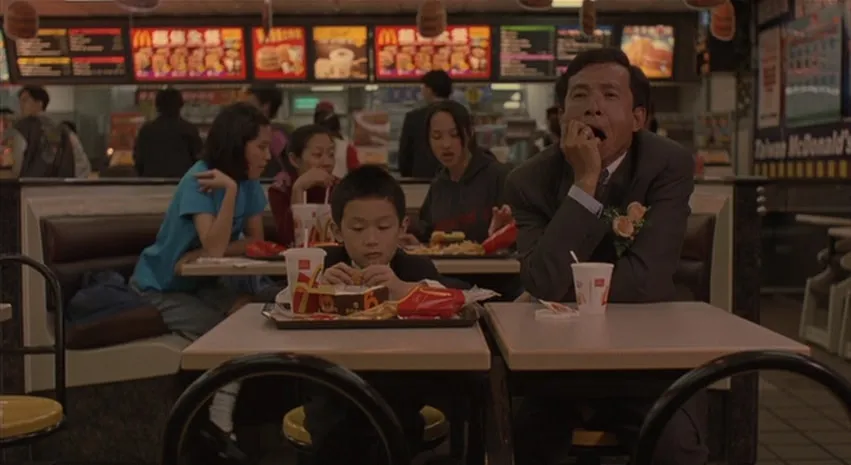 NJ takes Yang Yang to McDonald’s because he wasn’t eating at the wedding.
Maybe the difference in how family relations are handled is very much a reflection of cultural difference or the 25-year time difference between these two movies. I’m not sure. I appreciate both.
I appreciate Yi Yi for showing the unfiltered conflict of closeness in a tight-knit family. That patterns, however problematic, are also what make the uniqueness and sometimes, the glue of a family. Not every pattern needs immediate fixing or resolution; most of the time they get passed on. I appreciate Sentimental Value for showing that repair can happen intergenerationally and through minimal verbal expression, however distant it might seem from the viewer’s perspective. I prefer the latter for the same reason I left the cinema feeling light: it offers hope and reality that feels relieving and grounded.
There is hope in Yi Yi, as well. My favourite part of the movie is when Yang Yang reads a letter at his grandma’s funeral — a cycle of life completing, holding together the plot of chaos. “I want to show people what they can’t see,” I remember him saying. And here’s the full script of this heartwarming moment:
Grandma, there is so much I don’t know, so guess what I want to do when I grow up. I want to tell people things they don’t know, show people things they can’t see. That must be fun every day. One day I might find out where you went. When I do, may I tell people to come with and visit you?
婆婆,我不知道的事情太多了。你知道我以後想做什麼嗎?我要去告訴別人他們不知道的事,給別人看他們看不到的東西。我想,這樣一定天天都很好玩。說不定,有一天我會發現你到底去了哪裡。
I loved this scene and every other part with Yang Yang’s perspective; I smiled through most of them. At the same time, I couldn’t help but see an invisible burden on the boy’s shoulders — a lone dreamer executing the capacity to imagine for almost an entire family. It’s not burden to him, of course, it’s “fun”. I can’t seem to identify with this child-like wonder anymore, only resonate with it and wholeheartedly appreciate it. I’m not looking for hope in the form of a dream that perpetually begins and needs no completion.
I need hope grounded in the possibility of repair and forward movement when generations take small, timid steps together. It’s not repair that comes from starting a blank page, but repair that goes back to the torn and crumbled paper, to smooth it and start writing again.